Research Program 2. Sustainability-Enabling Interfaces for Plastic and Biomass Upcycling
Background
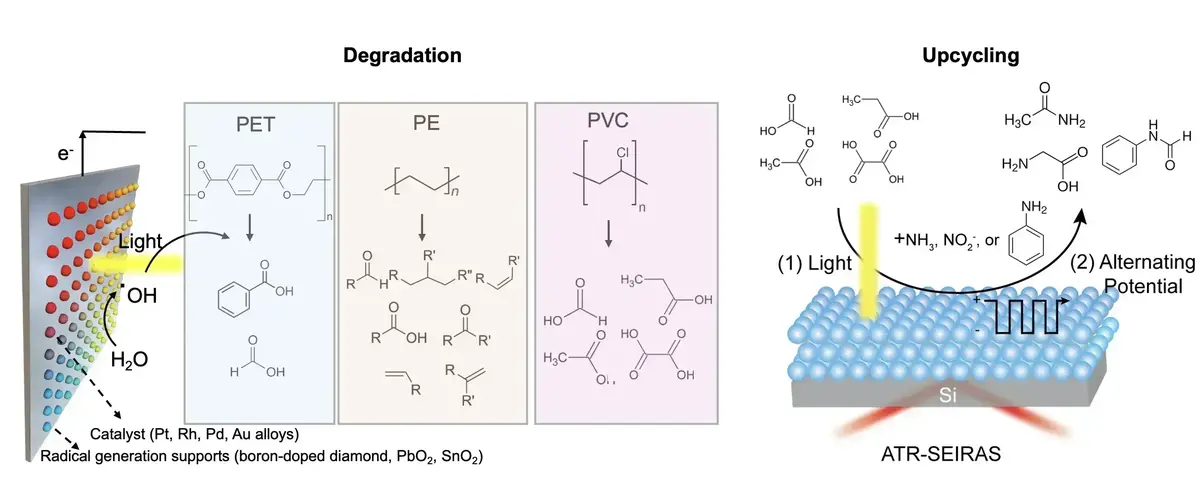
Plastics are indispensable to modern society due to their durability and versatility, yet their reliance on petroleum feedstocks has created severe environmental challenges. Nearly 80% of plastics accumulate in landfills or the environment, with less than 10% effectively recycled, leading to widespread micro- and nanoplastic pollution with ecological and health risks. While polymers such as polyethylene terephthalate (PET) can undergo hydrolytic degradation, most commodity plastics, including polyethylene (PE), polypropylene (PP), polystyrene (PS), and polyvinyl chloride (PVC), have inert C–C backbones that resist depolymerization. Current recycling relies on energy-intensive thermochemical processes (e.g., pyrolysis >500 °C), producing complex mixtures and significant greenhouse gas emissions. Achieving true plastic circularity requires not only efficient depolymerization but also selective conversion of products into value-added chemicals. Electrochemical and photoelectrochemical approaches powered by renewable energy offer promising alternatives, but are limited by low activity, poor selectivity, and catalyst instability. Addressing these challenges requires strategies that couple efficient catalytic conversion with dynamic control of interfacial environments.
Goals
Our goal is to enable efficient and selective plastic degradation and upcycling by engineering electrochemical and photoelectrochemical interfaces. By integrating interfacial design with operando characterization techniques, including ATR-SEIRAS and Raman spectroscopy, we probe local reaction environments, track intermediate dynamics, and establish structure–function relationships at interfaces. These insights guide the development of catalytic systems and scalable pathways for plastic upcycling, with broader implications for the valorization of complex feedstocks such as biomass.
Related Publication
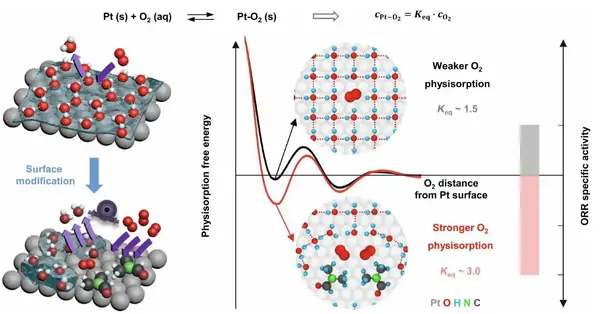
Huang, J.†; Peng, B.†; Zhu, C.†; Xu, M.; Liu, Y.; Liu, Z.; Zhou, J.; Wang, S.; Duan, X.; Heinz, H.*; Huang, Y.* Surface molecular pump enables ultrahigh catalyst activity. Sci. Adv. 2024, 10, eado3942