Research

Research Vision
Modern chemical manufacturing and the energy industry supply essential chemicals and fuels for agriculture, transportation, healthcare, and consumer products sectors, yet many foundational processes remain energy-intensive and carbon-intensive. As global demand for chemicals and fuels continues to grow, developing sustainable and scalable alternatives is imperative.
Electrified chemical processes powered by renewable electricity offer a compelling pathway. These approaches enable the conversion of abundant, low-value feedstocks, such as carbon dioxide, wastewater-derived species, and plastic waste into valuable chemicals and fuels. However, their practical implementation is limited by sluggish multi-electron transfer kinetics, low selectivity, and catalyst instability under operating conditions. Overcoming these barriers requires catalytic materials that are active, selective, and durable. Conventional discovery relies on slow, sequential trial-and-error workflows that cannot efficiently explore vast material and process spaces.
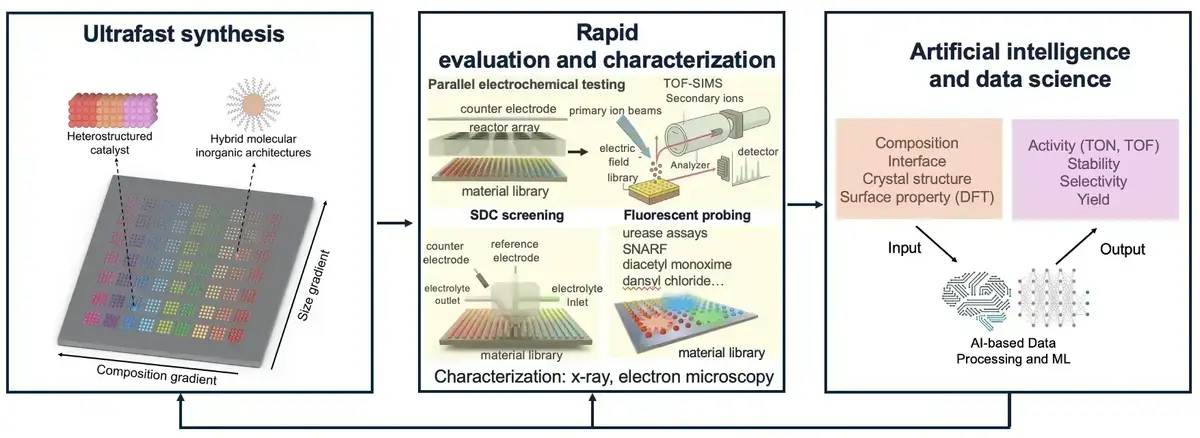
Our research establishes a new paradigm that integrates high-throughput experimentation with artificial intelligence (AI) to accelerate materials discovery and uncover governing principles across reactions, materials, interfaces, and reactor design. By coupling large-scale experimental datasets with machine learning, we develop predictive models that guide synthesis, identify key descriptors, and enable autonomous optimization of complex electrochemical systems.
Our vision is to discover efficient catalysts, engineer dynamic interfaces, and design scalable devices for the electrochemical conversion of low-value feedstocks into high-value products. Central to this effort are materials discovery platforms, centimeter-scale systems that encode millions of materials with controlled compositions, sizes, and structures, combined with AI-driven frameworks that transform data into actionable insight, enabling rapid exploration and rational design across complex chemical spaces.
Our Integrated Research Ecosystem
Broader Impact:
- Enables scalable, sustainable chemical technologies by linking atomic-scale catalyst design to system-level performance
- Advances clean energy and climate solutions through efficient electrochemical transformations
- Advance circular manufacturing by converting waste-derived feedstocks into value-added chemicals
- Creates large experimental datasets that power AI-driven discovery and open data practices
Our Program:
-
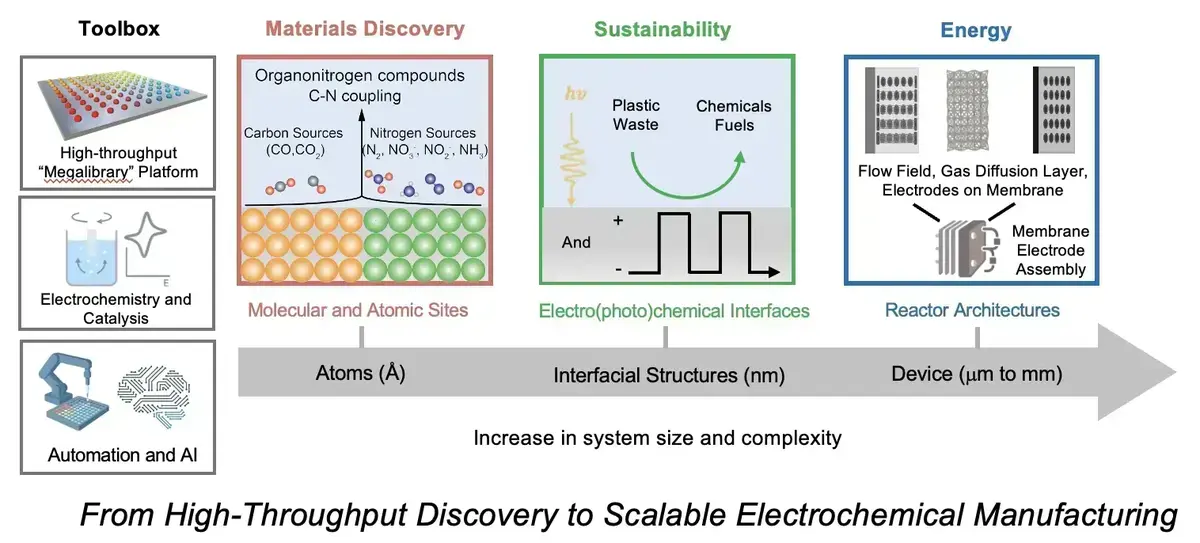
Research Program 1. Catalytic Materials Discovery for Efficient C-N Coupling
Research to discover efficient catalysts and establish general design principles by integrating high-throughput synthesis, screening, and characterization with AI-assisted analysis and optimization.
-
Research Program 2. Sustainability-Enabling Interfaces for Plastic and Biomass Upcycling
Enabling efficient and selective plastic degradation and upcycling by engineering electrochemical and photoelectrochemical interfaces.
-
Research Program 3. Energy-Efficient Device Development and Seamless Catalyst–Reactor Integration
Designing and optimizing high-throughput electrochemical reactors for scalable bond formation (e.g., C–N coupling) and to establish a closed-loop, data-driven framework that integrates high-throughput experimentation with AI-guided optimization.
-
Research Program 4. Heterogeneous Electrochemical Cross-Coupling Reaction Platform
Developing heterogeneous electrochemical cross-coupling methodologies and elucidate their mechanisms using megalibrary platforms.
More exciting directions are coming!