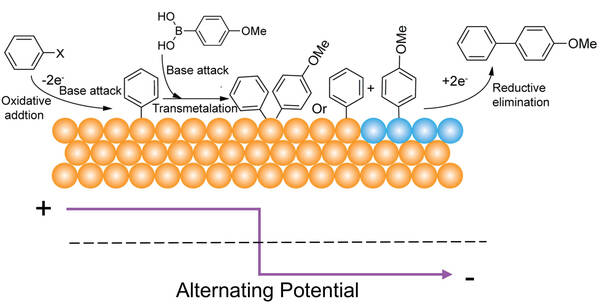
Research Program 4. Heterogeneous Electrochemical Cross-Coupling Reaction Platform
Background
Cross-coupling reactions are foundational for forming C–C and C–X bonds in pharmaceuticals, agrochemicals, and polymers. Conventional methods rely on homogeneous catalysts that require transition metals, complex ligands, and stoichiometric oxidants or reductants, leading to energy-intensive, multistep processes with significant waste and limited catalyst recyclability. Electrochemistry offers a compelling alternative for redox-driven synthesis, enabling high local concentrations of reactive intermediates and selective activation under mild conditions through precise potential control. While homogeneous electrocatalytic systems demonstrate feasibility, they typically operate within narrow potential windows, at low current densities, and face challenges in stability and recycling, limiting scalability. Heterogeneous electrocatalysis using inorganic materials provides a promising path forward, offering robust stability, recyclability, and tunability in composition, structure, and morphology. These systems enable enhanced control over charge transfer, access to higher current densities and potentials, and new reaction pathways governed by adsorption–desorption equilibria and interfacial proton and electron transfer. Despite these advantages, systematic approaches to discover and optimize heterogeneous electrocatalysts remain underdeveloped, limiting mechanistic understanding and the establishment of general design principles.
Goals
Our goal is to develop heterogeneous electrochemical cross-coupling methodologies and elucidate their mechanisms using megalibrary platforms. By integrating high-throughput experimentation with data-driven analysis, we aim to identify active catalyst motifs, uncover governing principles, and enable scalable, sustainable synthesis of value-added organic molecules, advancing the electrification of chemical manufacturing.